
At CalCo, we believe people make better decisions when they understand what they’re buying. So we wrote a guide that covers what actually matters about windows. No spec sheets you need a degree to read, no fine print to squint at. Just the stuff worth knowing, in plain terms, so you can decide what’s right for your home.
Every CalCo window is the top-spec window. ConserVision 800 glass standard. Lifetime warranty. Made in USA.
They’re responsible for 25-30% of a home’s energy loss. After the roof, they’re the most important decision you’ll make about your home’s envelope, and the one most people spend the least time researching.
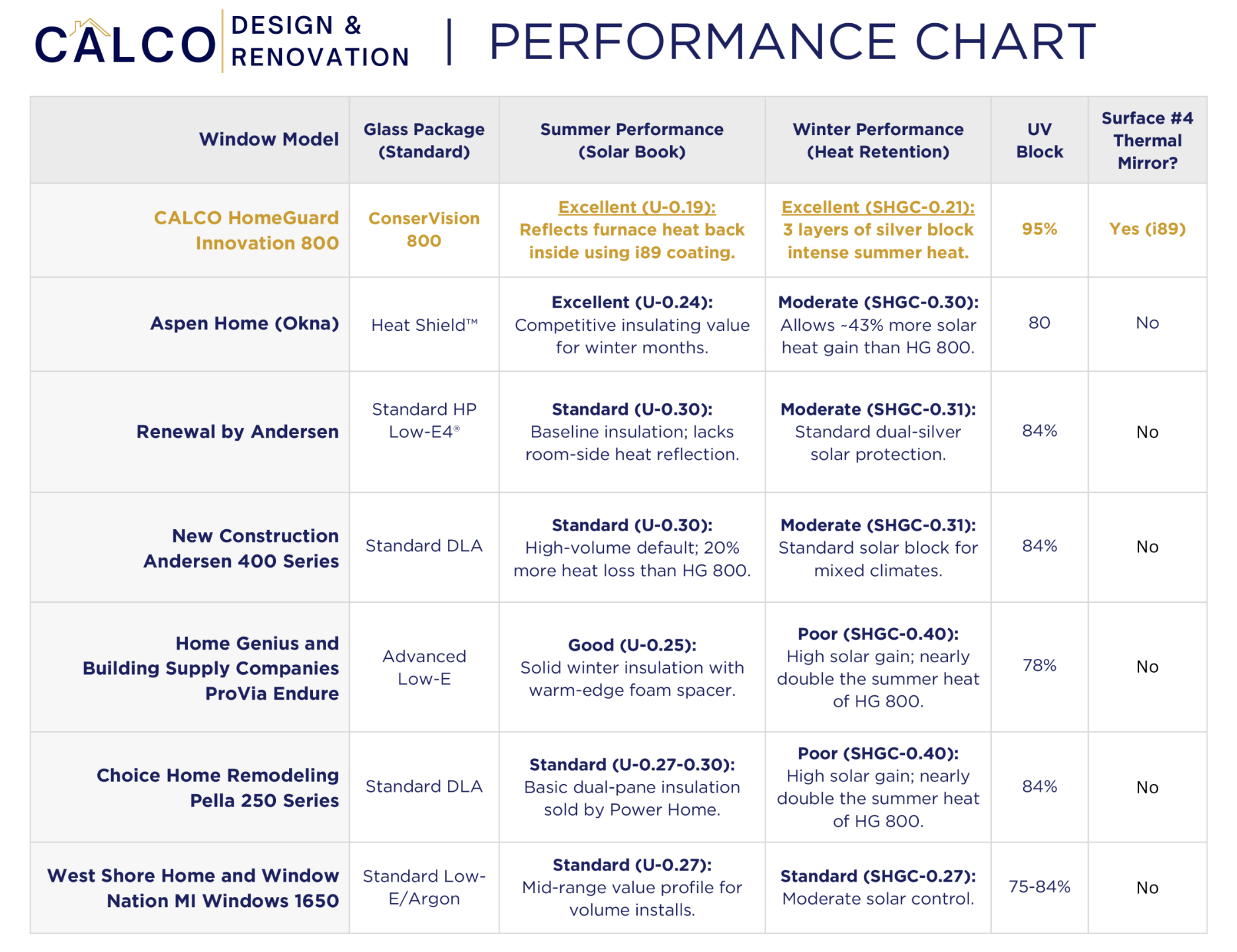
U-Factor measures how well a window holds heat in winter. SHGC measures how well it blocks summer heat. Lower is better on both. Once you know these two numbers, you can read any window quote.
It’s called Surface #4. It’s a thin layer on the room-side of the inner pane that reflects your furnace heat back into the room. Ask if your quote includes it — it’s one of the clearest signals of a top-tier glass package.
Most window warranties sound great on the cover and shrink in the details. The words to look for: lifetime, non-prorated, transferable, includes glass breakage. If any of those are missing, the warranty isn’t really a lifetime warranty.
Most of what makes a window good (or not) comes down to three things: the glass, the frame, and the warranty. Here’s what to know about each.
The glass is doing 80% of the work. It’s what keeps your living room warm in January and cool in July. It’s what stops your couch fabric from fading. It’s what determines whether the wall next to the window feels comfortable to sit near, or whether you’ve quietly started avoiding that corner of the room.
A measure of how much heat escapes through the window. The lower the number, the better the window holds heat in during winter. Most quotes you’ll see in our region land between 0.27 and 0.30. Anything at 0.24 or below is genuinely good. CalCo’s standard glass comes in at 0.19, which is exceptional for a dual-pane window.
A number between 0 and 1 that tells you how much of the sun’s heat passes through the glass. Lower is better in a climate like ours, where summer afternoons hit 90 with full sun on the south side of the house. Most “standard” packages come in around 0.30. Anything at 0.25 or below is ideal.
A measure of how much ultraviolet light the glass blocks from entering your home. UV is what fades couch fabric, floors, artwork, and curtains over time. Most modern windows block 75% to 84% of UV. The premium glass packages block 95% or more, which is the difference between furniture that fades in five years and furniture that holds its color for decades.
Window glass has four surfaces: outside of the outer pane, inside of the outer pane, outside of the inner pane, and the room-side of the inner pane. That last one is “Surface #4.” A coating there reflects your furnace heat back into the room instead of letting it bleed out through the glass. Most premium windows don’t include this coating, even though it’s one of the bigger contributors to real-world comfort.
A bad frame doesn’t fail on day one. It fails in year ten. Corners warp. Sashes catch when you slide them. Seals give up and let condensation creep between the panes. The frame is hidden inside the wall, but it’s working hard every season and it’s the reason most windows look fine for a few years and tired by year fifteen.
No sagging in the middle. No bowing under wind load. No corners that drift out of square over time. The frame has to hold the glass in the exact same shape twenty years from now as it does the day it’s installed.
Hollow vinyl frames pass cold straight through to the interior. That’s where mystery drafts come from — not from the glass, but from the frame around it. A reinforced, insulated frame breaks that thermal bridge.
The glass is sealed to the frame. If the frame moves, the seal stresses. If the seal stresses long enough, it fails. A rigid, dimensionally stable frame is what makes a long glass seal warranty actually mean something.
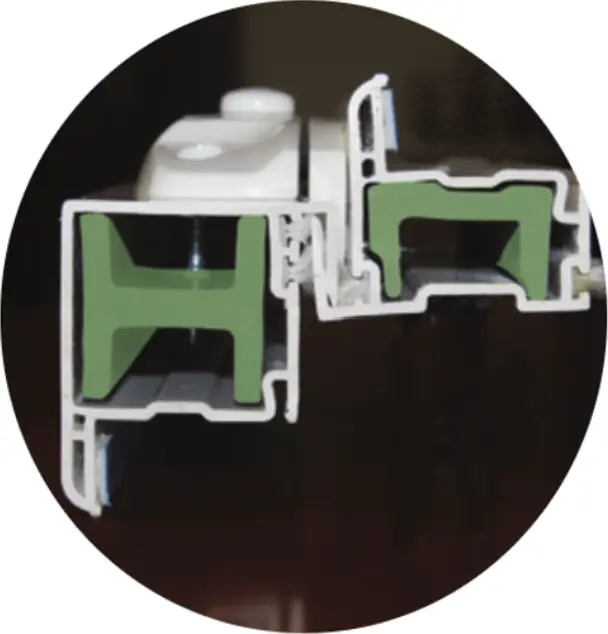
Keeps the frame rigid for decades.
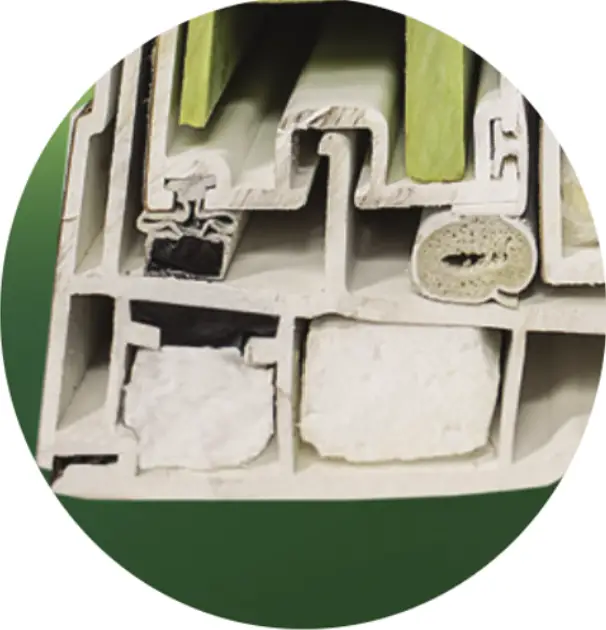
Breaks the thermal bridge through the frame.
Holds the glass seal under no stress.
A window’s warranty is where the real story shows up. The cover usually says “lifetime,” but most of the actual coverage hides in the fine print. Four words separate a real lifetime warranty from a marketing one.
Most window warranties run 10 to 20 years. After that, you’re on your own. A real lifetime warranty covers the window for as long as you own the home, with no expiration date. That’s what you should expect from something built into your house.
Most warranties pay 100% in year one and shrink every year after. By year ten, you might be covered for 30% of a replacement. Non-prorated means the coverage stays at 100% the entire time. Year twenty-five looks the same as year one.
Most warranties end the moment you sell the house. Transferable warranties move with the house to the next owner. That protects your investment if you ever sell, because the warranty becomes a selling point at the closing table instead of dying there.
Most warranties cover the seal but not the glass itself. If a stray baseball cracks the pane, you’re paying for replacement out of pocket. Glass breakage coverage means the warranty handles the actual glass too.
Independently tested for air, water, and structural performance
Energy performance numbers verified by an independent third party
Multi-manufacturer warranty backstop
Manufactured in Indiana, USA
The fastest way to evaluate a window quote is to ask the same questions of every contractor and see who can answer cleanly. CalCo’s windows pass every question on this list. Does yours?
You’re looking for both numbers under 0.25. Anything higher means the standard package is mid-tier or below.
A “yes” tells you the glass is doing real work in the winter. A “no” or a hesitation tells you the standard package is the contractor’s entry-level glass.
Metal spacers conduct cold and contribute to seal failure. Warm-edge (typically stainless steel or composite) is the modern standard.
Hollow vinyl is the volume default in the replacement window market. Reinforced and insulated frames stay rigid longer, don’t bridge cold, and protect the seal.
You want non-prorated. Prorated warranties shrink every year. By year ten, most prorated warranties cover 30% or less of a replacement.
Transferable warranties move with the house if you sell. Non-transferable warranties die at closing.
Most warranties cover the seal but not the actual glass. If a baseball cracks the pane, that’s on you unless glass breakage is explicitly included.
Either can work. A well-built dual-pane with triple-silver Low-E and a Surface #4 coating outperforms a basic triple-pane. Don’t let triple-pane marketing fool you into thinking more glass automatically means better performance.
Here’s a quick reference for the terms and benchmarks worth knowing.
| Term | What It Measures | What’s Good |
|---|---|---|
| U-Factor | How much heat escapes through the window in winter | 0.24 or below |
| SHGC | How much summer heat passes through the glass | 0.25 or below |
| Low-E Coatings | Reflective metallic layers that hold heat in | Triple-silver |
| UV Block | How much fading-causing UV light is blocked | 90% or higher |
| Surface #4 Coating | Room-side coating that reflects furnace heat back in | Yes |
| Frame Construction | What the window frame is made of and how it’s built | Composite-reinforced and insulated |
| Spacer | The piece separating the two glass panes | Warm-edge, stainless steel or composite |
| Warranty Terms | What’s actually covered, and for how long | Lifetime, non-prorated, transferable, glass breakage included |
You know what to look for. You know what to ask. The next step is sitting down with someone who can answer all of it. CalCo offers free in-home consultations across our service area. We bring samples, walk you through your specific home, and give you a quote that holds up against every question on this page.